
Death Valley.
Death Valley is the hottest, driest, lowest point in North America. It is also, under the right conditions, one of the most surreal and beautiful places on earth to say your vows. Most people don't know this. Most people have never seen it in winter. That's their loss.
This guide is going to tell you what Death Valley actually looks like as an elopement destination, when to go, what it costs (almost nothing), and the story of how our couple exchanged vows on a tiny island in the middle of a lake that shouldn't exist — and how they got there using trash bags.
How many days do you need?
Death Valley is close enough to LA to do in a weekend — 3 days is the sweet spot. Drive in Friday, shoot Saturday, explore Sunday, drive home. That's exactly what we did with Hugo and Ivonet.
A single overnight trip is technically possible, but you'll miss the magic. Death Valley changes character completely between sunrise and sunset, and you want to experience both. The dawn light at Badwater Basin and the golden hour at Mesquite Flat Dunes are two different planets — and they're both worth planning your trip around.

When to go.
This is the most important decision you'll make about a Death Valley elopement. Get the timing right and you'll have one of the most magical days of your life. Get it wrong and you'll be shooting in 120°F heat wondering why you didn't listen.
Winter (November – February) — The Only Real Option
Temperatures are mild (50-75°F during the day), the light is soft and cinematic, and the far-off mountains often have snow on them — which creates a stunning contrast against the desert floor. This is when we shot Hugo and Ivonet, and the conditions were perfect.
Winter is also when rare things happen. After significant rainfall, Lake Manly can reappear at Badwater Basin — a shallow, mirror-like lake that transforms the lowest point in North America into one of the most surreal landscapes on the planet. About once every decade, there's also a super bloom — when the entire desert floor erupts in wildflowers. You can't plan for these events, but if they happen during your window, drop everything and go.
Spring (March – April) — Possible But Warming Fast
Early spring can work. Temperatures are still manageable (75-95°F). Wildflowers from a super bloom can extend into March. By late April, it's getting too hot for comfortable outdoor anything.
Summer (May – September) — Do Not Go
We mean this literally. Death Valley holds the record for the highest reliably recorded air temperature on Earth (134°F). Summer temperatures regularly exceed 120°F. This is dangerous, not romantic. Do not plan an elopement here between May and September.
Fall (October) — Brief Window
October can work as temperatures drop back below 100°F. But it lacks the drama of winter — no chance of Lake Manly, no snow on distant peaks, no super bloom possibility.
The honest cost breakdown.
Death Valley might be the most affordable elopement destination in this entire guide. Here's the reality for a 3-day trip for two from Los Angeles:
- Park entry: $30 per vehicle (valid for 7 days)
- Wedding permit: ~$150 (required for ceremonies on NPS land)
- Gas from LA: ~$60-80 round trip (roughly 300 miles each way)
- Camping: $8-22 per night (Furnace Creek, Sunset, Stovepipe Wells, or backcountry free)
- Lodging (if not camping): $150-350 per night (The Oasis at Death Valley or Stovepipe Wells Village)
- Food: Bring it. Options inside the park are extremely limited and overpriced.
- Activities: $30-60 for sandboard rental (if you want to ride the dunes)
Estimated total: $400 – $1,200 for two people, pre-photography. If you camp (like Hugo and Ivonet did), you're looking at the low end. This was Ivonet's first time camping ever — and she decided her wedding weekend was the time to start. That's the kind of couple we love working with.
Where to stay.
The Oasis at Death Valley (Furnace Creek)
The only real "resort" in the park. Spring-fed pool, date palm gardens, air conditioning. If camping isn't your thing, this is where you stay. Book well in advance for winter weekends.
Stovepipe Wells Village
More rustic, more affordable, closer to the sand dunes. Basic rooms but clean and functional. The saloon serves surprisingly decent food.
Camping (What We Did)
Furnace Creek Campground and Sunset Campground are the main options — both first-come, first-served in winter. Backcountry camping is also free throughout the park with basic rules (2 miles from any road, no fires). If you've never camped before, Death Valley in winter is actually a gentle introduction — the weather is mild, the skies are absurdly clear, and you'll see more stars than you've ever seen in your life. Death Valley is a certified International Dark Sky Park.

The locations worth building a trip around.
Badwater Basin
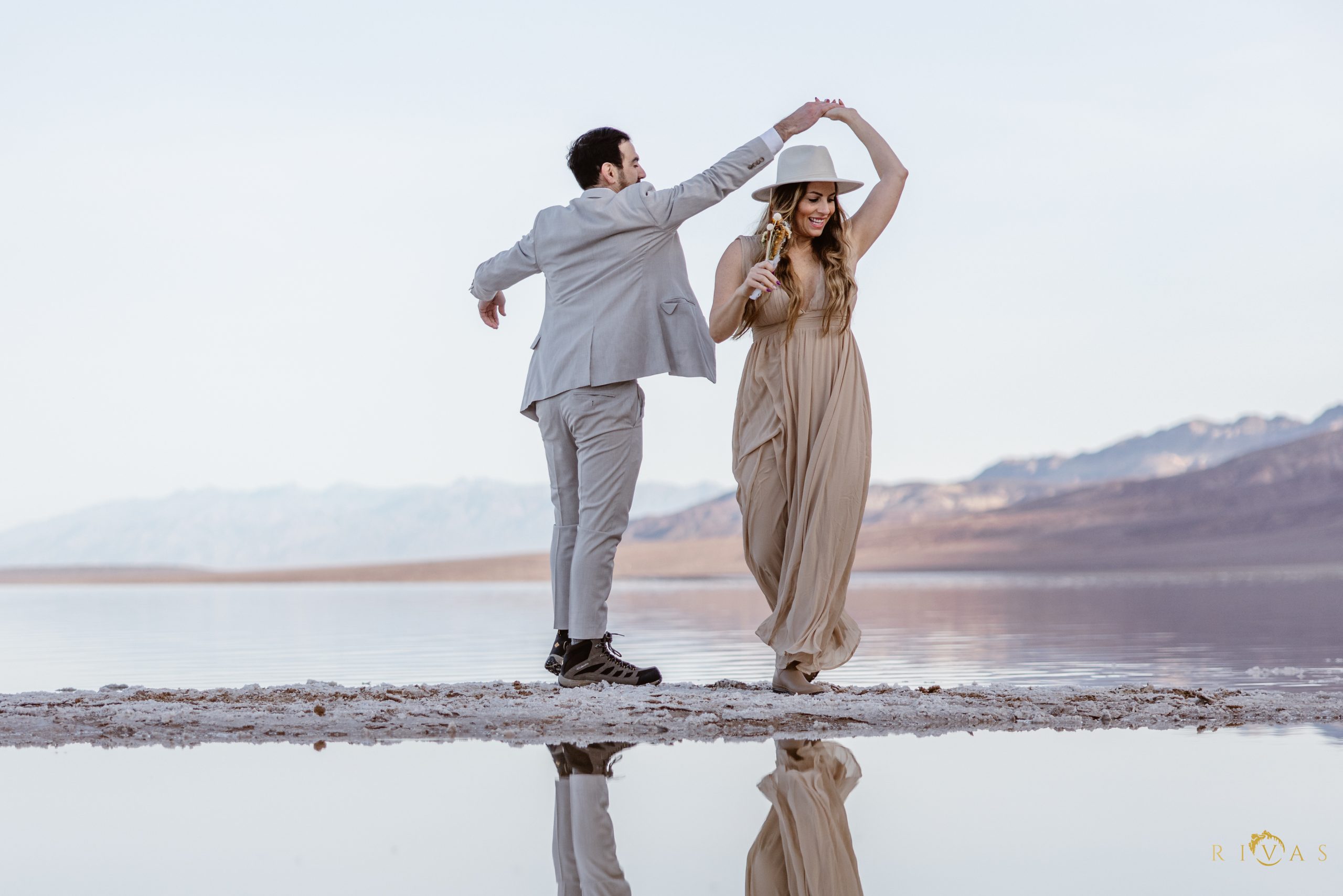
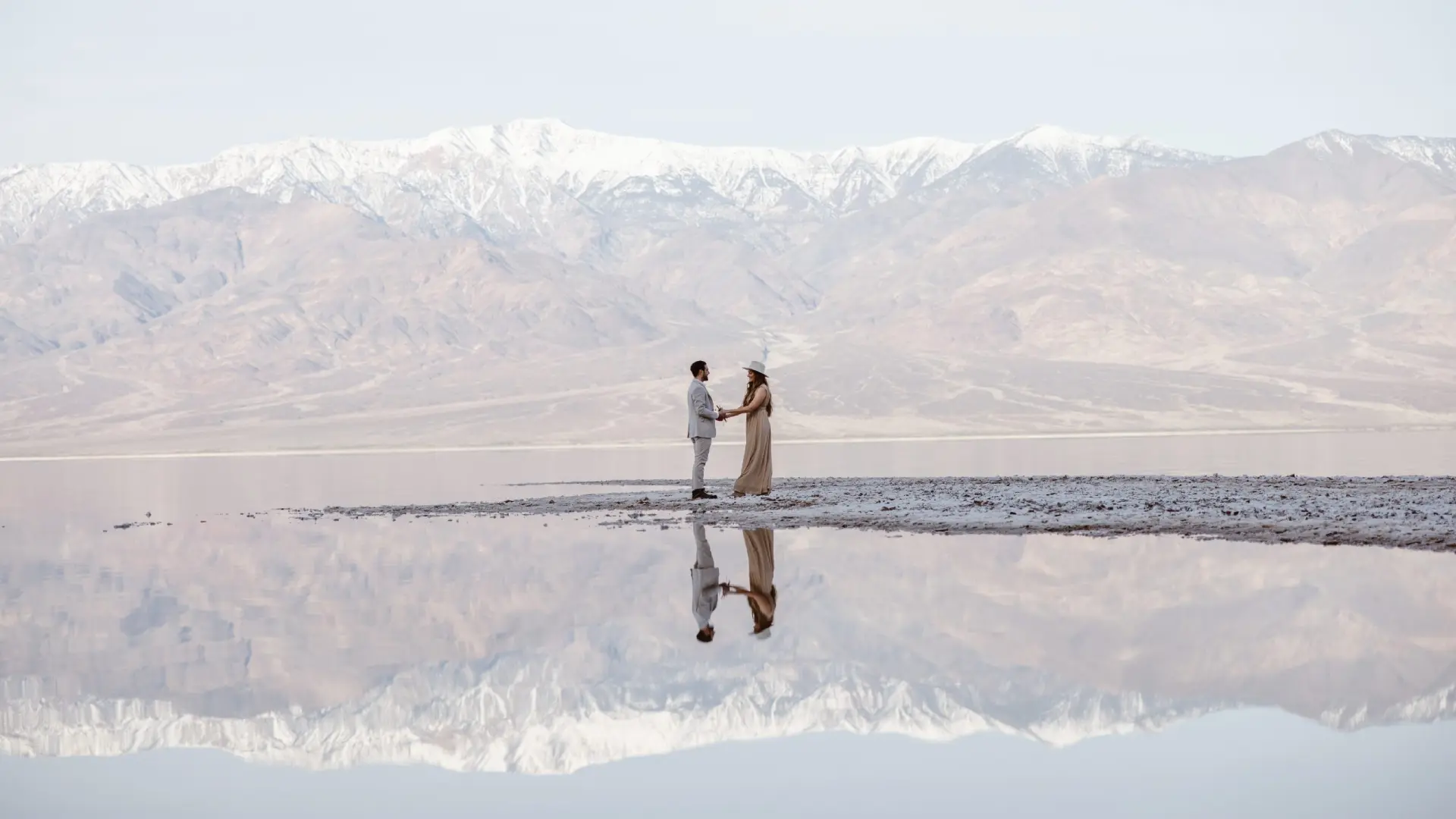
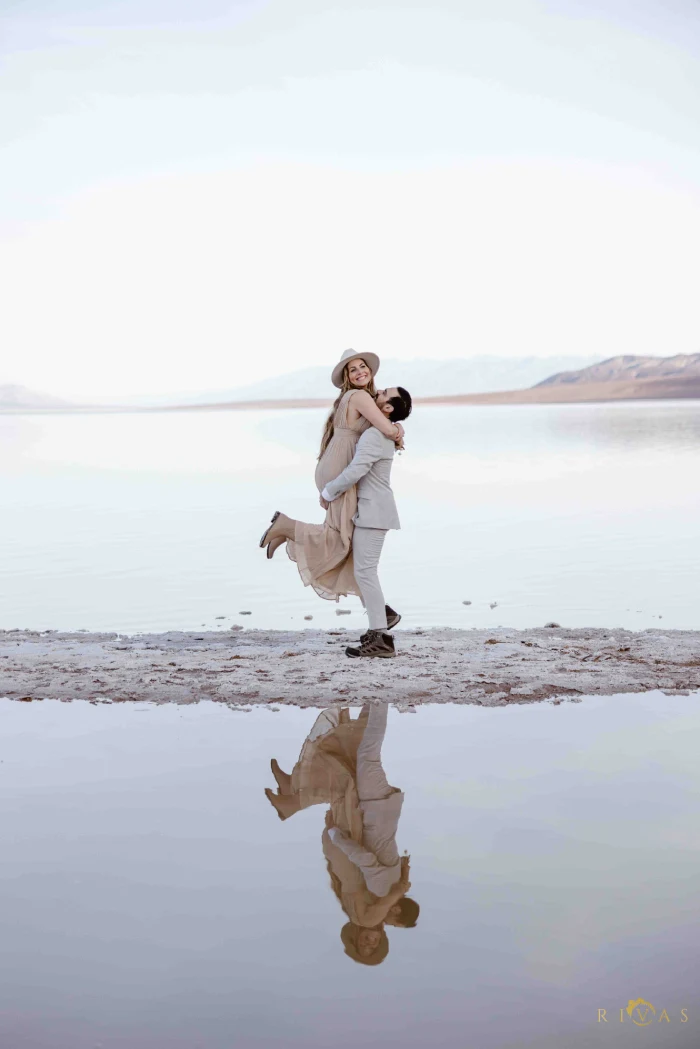
The lowest point in North America — 282 feet below sea level. Miles of white salt flats stretching to the horizon. In a normal year, it's a cracked, dry moonscape. In a rare year like 2024, it fills with water and becomes Lake Manly — a shallow, perfectly still mirror that reflects the entire sky and surrounding mountains. This is where Hugo and Ivonet said their vows.
Mesquite Flat Sand Dunes
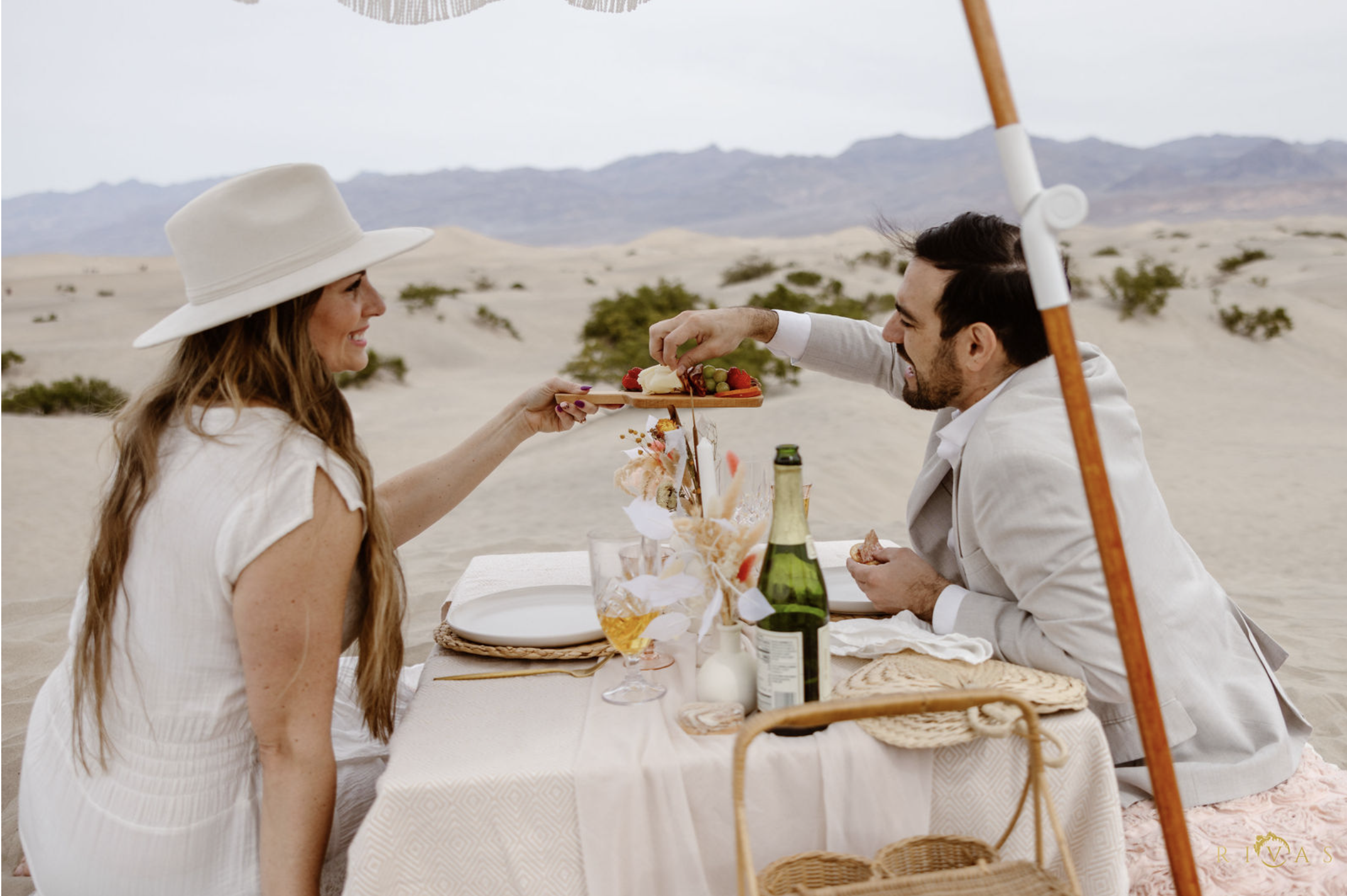
The iconic dunes you've seen in every Death Valley photo. Best at sunrise or sunset when the shadows create dramatic ridgelines across the sand. This is where Hugo serenaded Ivonet at sunset during their picnic — but more on that story below.
Zabriskie Point
Eroded badlands in layers of gold, brown, and amber. The most "Mars-like" viewpoint in the park. Short walk from the parking lot, best at sunrise.
Artist's Drive & Artist's Palette
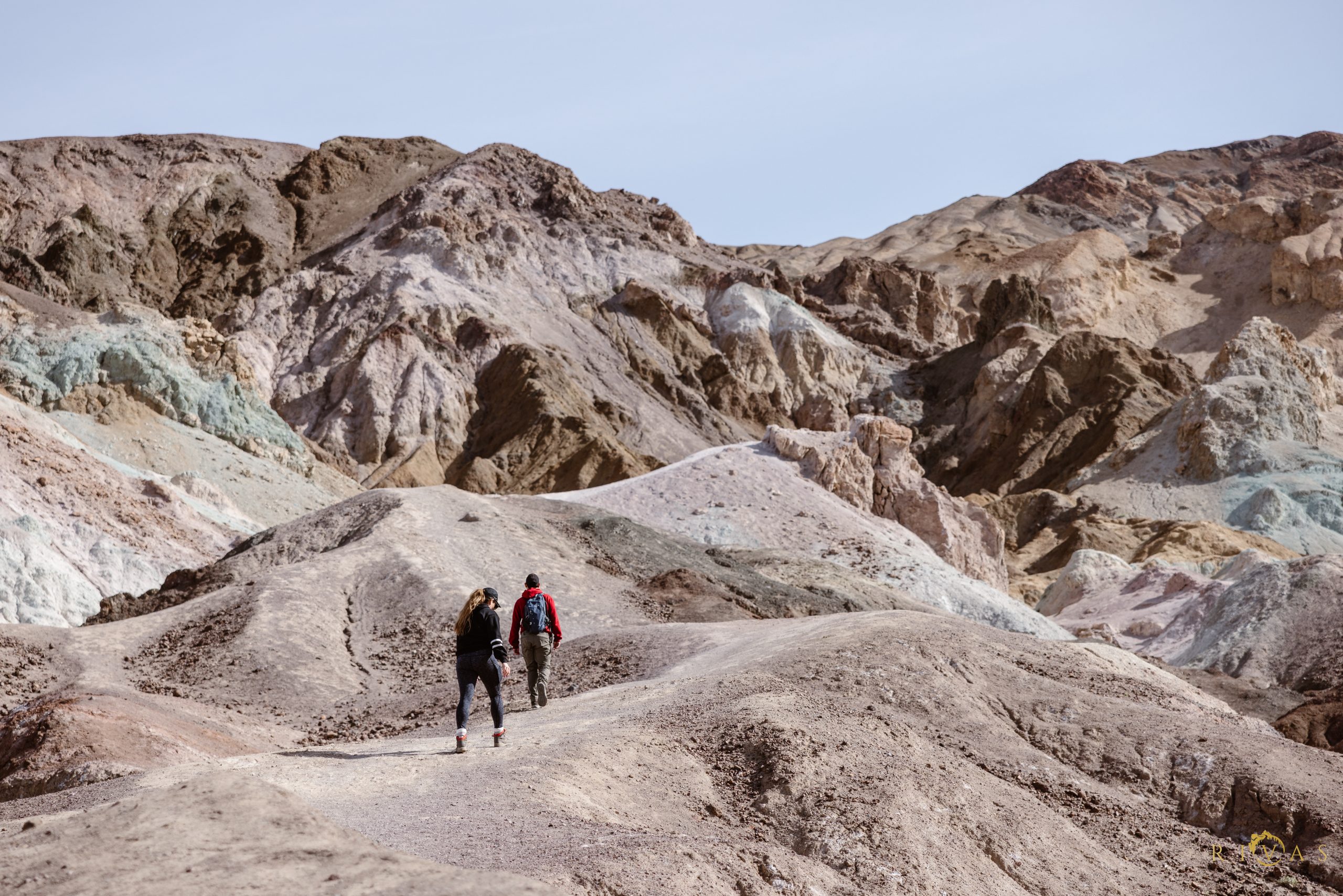
A 9-mile one-way loop through hillsides painted in green, purple, red, and gold mineral deposits. Best in late afternoon light. Feels like driving through a watercolor painting.
Dante's View
A 5,476-foot overlook looking down on Badwater Basin from above. If you want the "God's perspective" shot of the salt flats (or the lake), this is where you get it. Clear mornings only — haze builds by afternoon.
The trash bags, the island, and the vows.
Here's the story that makes this guide different from every other Death Valley blog post on the internet.
February 2024. We arrive at Badwater Basin before dawn with Hugo and Ivonet. Lake Manly is there — a shallow, impossibly still lake covering the salt flats as far as we can see. The mountains are reflected perfectly in the water. It looks like the sky got folded in half.
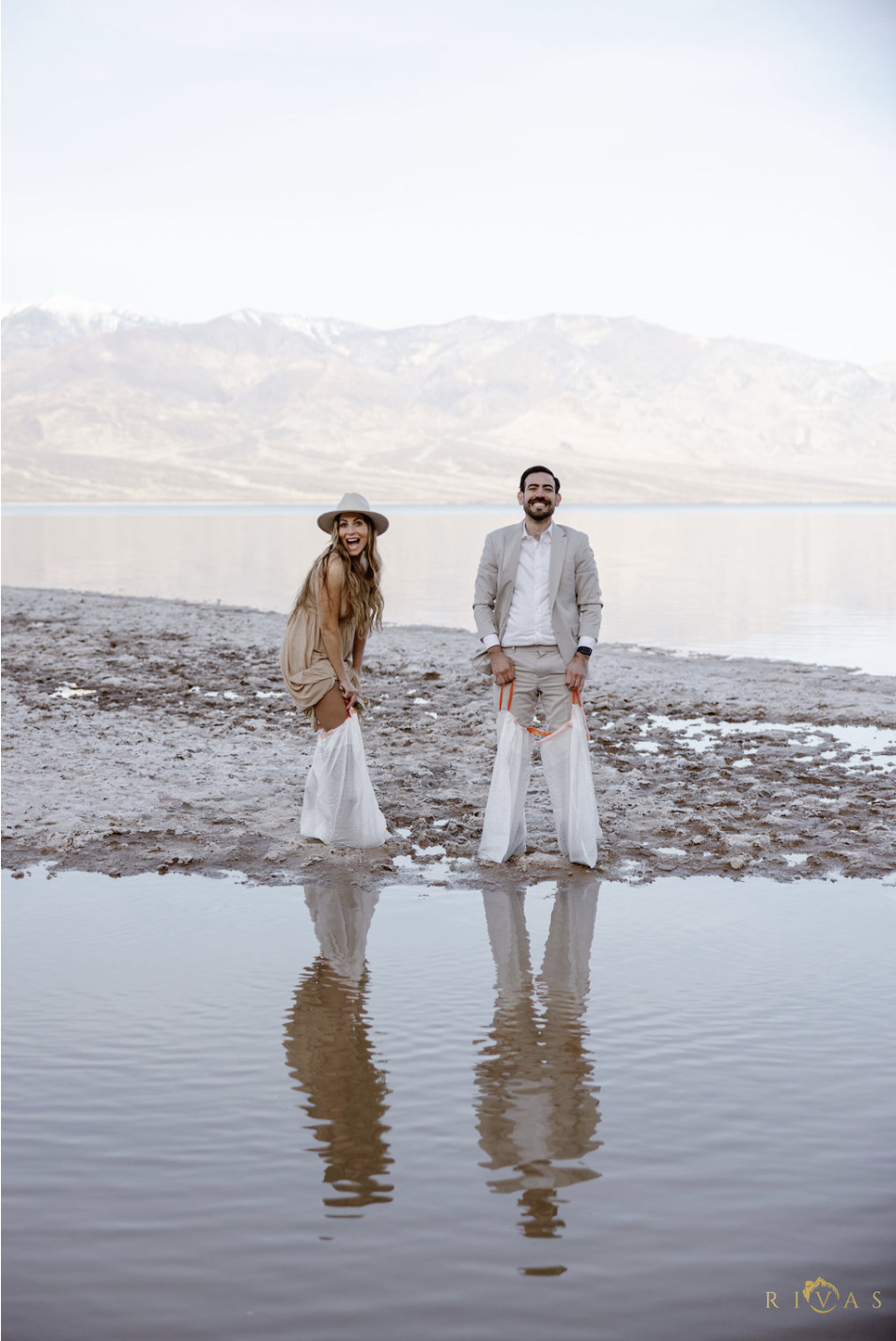
About ten yards from shore, I spot a small strip of dry land — a tiny island barely big enough for two people, completely surrounded by the mirror lake. I turn to Hugo and Ivonet and say: "If you can get out there, that's where you should say your vows."
The problem: the lake is shallow but salty. They're in a suit and a dress. Getting their clothes soaked in salt water before sunrise would ruin the rest of the day.
The solution: I had trash bags in my backpack.
We wrapped their legs in black trash bags, tied them at the waist, and Hugo and Ivonet shuffled through six inches of salt water to the tiny island like they were in a potato sack race. They were laughing so hard they could barely walk.
They made it. They stood on that island — surrounded by nothing but mirror water and mountain reflections — and said their vows at sunrise. Just the two of them, alone in the middle of a lake that shouldn't exist, in the lowest point in North America.
The sunset serenade on the dunes.
After the morning ceremony, we spent the afternoon hiking and exploring. By sunset, we headed to Mesquite Flat Sand Dunes for a picnic and sandboarding session.
What I didn't know until that moment: Hugo is a classically trained opera singer.
As the sun dropped behind the dunes, Hugo stood up from the picnic blanket, faced Ivonet, and sang Frank Sinatra's "My Way" — full voice, full power, in the middle of the desert with nobody else around for miles.
There are moments in this job where you forget you're working. Where the camera is rolling but you're not really thinking about composition or exposure anymore. You're just watching two people love each other in a way that makes the world feel smaller and kinder. This was one of those moments.
A sample 3-day itinerary.
This is roughly what we did with Hugo and Ivonet. Adapt it to your pace.
Day 1 (Friday) — Arrive & Scout
- Drive from LA (4-5 hours via 395 or I-15)
- Set up camp or check in at lodging
- Sunset at Zabriskie Point (20 minutes from Furnace Creek)
- Dinner under the stars — bring a camp stove or pack food from home
- Stargazing — Death Valley is one of the darkest places in the US
Day 2 (Saturday) — Elopement Day
- Pre-dawn departure for Badwater Basin (arrive before first light)
- Sunrise ceremony at the salt flats (or Lake Manly if timing and luck align)
- Late breakfast at camp
- Afternoon: hike Golden Canyon, explore Artist's Drive, rest
- Sunset: picnic at Mesquite Flat Sand Dunes + sandboarding
Day 3 (Sunday) — Slow Morning, Then Home
- Sunrise at Dante's View (overlook of entire basin)
- Coffee, break camp
- Drive home with a detour through Red Rock Canyon (adds 30 minutes, worth it)
What nobody tells you.
- Timing and luck is everything. Lake Manly only appears after significant rainfall — roughly once every few years. Super blooms happen about once a decade. You can't plan for either, but if you hear they're happening, go immediately. Don't wait. By summer, they'll be gone.
- Even without the lake, Death Valley in winter is stunning. Snow on the distant Panamint Range, mild temperatures, golden light on the salt flats at dawn. A "normal" winter weekend is still an incredible elopement.
- It's a certified International Dark Sky Park. The stargazing alone is worth the trip. On a clear winter night, you'll see the Milky Way with the naked eye — something most Americans have never experienced.
- Cell service is nonexistent. Download maps, download your timeline, tell someone where you'll be. This is real wilderness.
- Bring all your own food and water. There's one general store at Furnace Creek and that's basically it. Pack like you're going to the moon.
- Sand gets everywhere. If you're doing dune photos, accept that your shoes, camera, and hair will be sandy for the next week. Bring lens wipes.
- The park is massive. It's bigger than Connecticut. Don't try to see everything — pick 3-4 locations and do them well.
The bottom line.
Death Valley is the most underrated elopement destination in California. It's 4 hours from LA, it costs almost nothing, and under the right conditions it delivers landscapes that look like they belong on another planet.
Hugo and Ivonet came here for a weekend. It was Ivonet's first time camping. They said their vows on an island in a lake that shouldn't exist, wrapped in trash bags to keep their clothes dry, and ended the day with an opera serenade on the sand dunes at sunset.
That's the kind of elopement we live for. If it sounds like yours — you know where to find us.
Death Valley, through our lens.
A few frames from one of the most unforgettable elopement weekends we've ever shot — the trash bags, the lake, the serenade, and the stars.

Planning a Death Valley
elopement? Let's talk.
We know the salt flats, the dunes, the timing, and the art of getting two people in formalwear across a lake using trash bags. Let's plan your day together.
Send an Inquiry →